







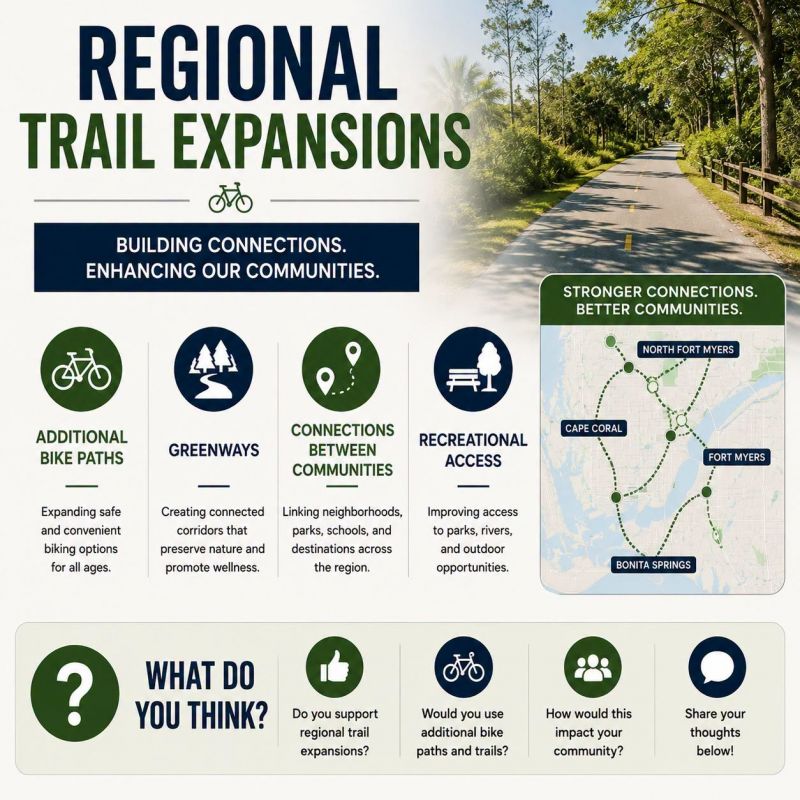
Southwest Florida is experiencing rapid growth, and with that growth comes a greater need for transportation options, recreational spaces, and connections between communities. While new residential developments and commercial projects often make headlines, another significant effort is quietly taking shape across the region: the expansion of regional trails and greenways.
Several trail projects are currently being planned, studied, or expanded throughout Lee, Collier, Hendry, Glades, and neighboring counties. Together, these projects aim to create a more connected network for walking, biking, recreation, and alternative transportation.
Why Regional Trails Matter
Modern trail systems serve a much larger purpose than recreation alone.
Well-designed multi-use trails can:
- Connect neighborhoods to parks, schools, and businesses
- Improve pedestrian and cyclist safety
- Encourage healthier lifestyles
- Support eco-tourism
- Provide alternative transportation options
- Increase access to natural areas and waterfronts
- Help reduce short vehicle trips
As Southwest Florida continues to grow, regional trails are becoming an increasingly important part of long-range transportation planning.
Bonita Estero Rail Trail (BERT)
One of the region's most anticipated projects is the Bonita Estero Rail Trail (BERT).
The proposed 14.9-mile multi-use trail would follow portions of the former Seminole Gulf Railway corridor, connecting:
- Estero
- Bonita Springs
- Southern Lee County
- Northern Collier County
If completed, the trail would link with existing and future regional trail systems, creating new opportunities for walking, running, cycling, and commuting.
The project is still in the planning stages, with design, funding, and implementation continuing to move through the public process.
Florida Gulf Coast Trail
Another ambitious long-term vision is the Florida Gulf Coast Trail.
This proposed regional trail network could eventually stretch approximately 420 miles, connecting communities from Naples to the Tampa Bay area.
The concept would link existing trails while filling in missing connections to create one of Florida's largest continuous multi-use trail systems.
While this project will likely be completed in phases over many years, it represents a significant vision for regional connectivity.
John Yarbrough Linear Park Extension
Fort Myers residents are also watching progress on the John Yarbrough Linear Park Trail.
Plans are moving forward to extend the existing trail north toward Hanson Street, providing improved connections within the city.
The extension would enhance access for pedestrians and cyclists while creating additional links to neighborhoods, parks, and future trail corridors.
Fort Myers–North Fort Myers Urban Trail
Lee County is studying another important connection that could benefit residents throughout the region.
The proposed Fort Myers–North Fort Myers Urban Trail would provide a new trail crossing over the Caloosahatchee River, connecting:
- Downtown Fort Myers
- North Fort Myers
- Cape Coral trail systems
- Florida's SUN Trail Network
If developed, the project would strengthen regional mobility while expanding recreational opportunities on both sides of the river.
Florida Heartland Regional Trail
Beyond the coast, planners are also exploring the Florida Heartland Regional Trail, a proposed network connecting multiple inland counties.
The long-range vision includes connections through:
- Collier County
- Hendry County
- Glades County
- Highlands County
- Hardee County
- Polk County
Potential corridors include the Paradise Coast Trail, the Marco Island Loop, and the State Road 29 Trail, helping connect rural communities with larger regional networks.
Expanding Local Community Connections
In addition to these major projects, Lee and Collier counties continue studying opportunities to expand local trail systems.
Future concepts include:
- Shared-use paths
- Protected bike lanes
- Greenways
- Park-to-park connections
- School access improvements
- Neighborhood trail links
- Business district connections
Many of these projects are designed to integrate with larger regional trail networks over time.
Benefits Beyond Recreation
Although trails are often associated with outdoor recreation, they also provide important economic and transportation benefits.
Communities with connected trail systems often experience:
- Increased property values near trails
- Greater tourism and outdoor recreation spending
- Improved public health through active lifestyles
- Reduced traffic congestion for short local trips
- Enhanced quality of life for residents
As Southwest Florida grows, these investments can help create communities that are not only larger but also more connected and accessible.
Looking Ahead
Most of these trail projects remain in various stages of planning, design, environmental review, or funding. As with any major infrastructure initiative, timelines, routes, and project scopes may evolve before construction begins.
Still, the long-term vision is clear: creating a regional network that safely connects communities while expanding opportunities for recreation, transportation, and outdoor enjoyment.
For residents who enjoy biking, walking, running, or simply spending time outdoors, these trail expansions could shape the future of Southwest Florida for decades to come.
Disclaimer: This article is based on publicly available transportation plans, regional planning documents, trail studies, and government planning information. Project routes, funding, environmental reviews, timelines, and final designs remain subject to change as planning and public review continue.